Collaborative
brAIns
Illinois State's community of educators embraces emerging technologies with creativity and care
By Tommy Navickas
The news cycle offers constant reminders.
Striking new milestones in artificial intelligence (AI) are met in exponentially quicker timelines. Every industry is affected. Teaching, the profession that creates all other professions, is at a critical juncture. In this context, the question educators face is not whether new technologies will appear in classrooms and communities—but how schools can respond thoughtfully, ethically, and collaboratively as that landscape continues to shift.
The faculty in the College of Education and its pre-K-12 Laboratory Schools are busy discovering new, effective, and safe applications together. At the center of the conversation is the Education Now Lab, a community-engaged, interdisciplinary research and practice space where Illinois State and the larger community design responses to emerging technologies that prioritize learning, relationships, and community needs over speed or novelty.
“It takes multiple perspectives to move anything forward in a meaningful way,” said Dr. Anna Smith, a professor in the School of Teaching and Learning and an Illinois Innovation Network Fellow, who founded the Education Now Lab during the pandemic with her doctoral students.
“Our goal is to leverage the expertise of teachers, community members, students, and faculty with research and practice to address real problems people are facing right now.”
Together, the lab’s projects reflect a multipronged approach to navigating technological change. Some work focuses on helping decision‑makers slow down and ask better questions before adopting new tools. Other efforts examine how technologies already present in classrooms can be tested, constrained, and studied with care. Still others attend to the broader community—especially groups often left out of technology conversations entirely.
The policy simulator
Consumers experience post-purchase regret for items as mundane as toothpaste. Imagine the stress of investing in the wrong educational technology for a classroom, school, or district?
That’s why the Education Now Lab is developing a policy simulator tool. The idea is to help administrators make decisions about products and policies for technologies. Emphasis is on holistic, communitywide evaluation in lieu of a magic bullet model.
“It’s not going to give administrators all the answers—it’s meant to spark conversations before decisions get made,” Smith said.
After analyzing an educational community’s needs, the simulator gives leaders an initial list of potential outcomes for different decisions. Privacy is an increasingly difficult factor to manage. Many technologies are less expensive because they feed school data to corporate entities, explains Smith.
“It will show what might be some of the intended and unintended impacts of an option—on your budget, on maintenance, on the learning environment,” Smith said.
Because of the impact a required tool or app can have on the learning environment, the Education Now Lab has begun its work by testing teachers’ pedagogical decision-making with AI products their districts have purchased and are encouraging them to use.
This part of the process is the top priority. Administrators receive a detailed understanding of how fluid or disjointed the classroom experience becomes based on teachers’ interactions with various products.
“Based on our research, the simulator is going to prioritize things like relational knowledge—the things you don’t know unless you’ve been in a classroom with a learner for months,” Smith said.
“We’re trying to think across the whole system, not just one piece of it,” she said.
The result? Fewer decisions trashed next to the charcoal toothpaste.
Metcalf GPT
As generative AI is increasingly being built into commercial products for the classroom and comes with distinct ethical issues to take into consideration, the Education Now Lab is studying its responsible use to surface tradeoffs, limitations, and instructional questions that arise. Commercial AI products, for instance, store data indefinitely.
That’s a stop sign for most schools, explained Andy Goveia, an award-winning middle level teacher at Thomas Metcalf School, the University’s pre-K-8 Laboratory School.
But what if a custom, closed-circuit version could be created to run on Illinois State’s servers?
“No problem,” said Dr. Roy Magnuson.
In addition to being a professor of music at Illinois State, Magnuson is the director of the University’s Adaptive Edge Institute (AEI), focused on understanding and responding to emerging technologies. The AEI and Education Now Lab are collaborating on this AI-in-the-classroom project.
“The chatbot-like system is given parameters that focus it in on only the information that we give it,” Goveia said.
“Instead of it being open-ended, it’s given a set of credible resources, pedagogies, and other content that limit its responses to the specific knowledge base we have given it.”
In collaboration with fellow Metcalf teacher Zack Gilbert, the pair will study how this AEI-tailored model is put into practice through a pilot in Metcalf’s fifth-grade social studies classroom.
“Zack and I will be able to be thought partners to troubleshoot that piece,” said Goveia, who’s often tapped as a go-to tech expert in his career and personal life.
“The goal is to determine, ‘How do you help kids still be critical thinkers, learn content, and prevent them from giving up their brains to the AI?’” he said.
Goveia, Gilbert, and the Education Now Lab team will also get a chance to do bias testing and edit the custom tool’s functionality.
“AI products out there can be a great tool, but you can’t fully trust it from a content perspective just yet. It has provided some inaccurate information here and there, and that’s not something we can ‘fix’ on our end,” Goveia said.
Connected stories
While much public attention is focused on artificial intelligence, the Education Now Lab underscores that technological change affects communities unevenly—and that foundational digital literacy remains a pressing issue across generations.
“Digital literacy is not being addressed for older populations in the community,” said Kristi Sutter, an instructional facilitator and makerspace teacher at Metcalf.
In brainstorming how to address this issue, the lab group agreed that the best way to pique grandparents’ interest was to involve their grandchildren.
“And the most powerful way to connect those groups is through storytelling,” Sutter said.
Here’s their plan:
Near Grandparents’ Day (September 13), Metcalf kindergarten, second-grade, and middle school students will join their “nanas and papas” in the school’s Imaginarium space. They’ll meet weekly over the course of a month.
The grandparents will bring in their personal electronic devices, photos, and share personal backstories behind their images.
Sutter recruited the McLean County Genealogical Society to lead an exchange about family trees, the differences among families, and how life has changed across generations.
Then comes the digital literacy support. Grandkids will help their grandparents scan and upload their photos.
“They’ll also discuss safe ways to do genealogy research and navigate the internet using the grandparents’ own technology,” Sutter said. “So, it’s device agnostic.”
Before the meetup, Sutter will collaborate with Metcalf teachers to develop lessons on listening and digital literacy through storytelling. “We thought this would be a perfect opportunity to start talking about consent—getting permission to use other people’s stories and images before they’re posted somewhere,” Sutter said.
“They’ll also learn how to be active listeners instead of rote interviewers. That will help create meaningful intergenerational understanding.”
The lab will “open source” the initiative, starting with Westminster Village, Normal Public Library, and McLean County Museum of History, before extending to surrounding areas, including turning the exchanges into a traveling digital storytelling display in collaboration with Illinois State’s Milner Library.
“We’ll be able to work out the kinks here at Metcalf before we share it with the larger community,” Sutter said.
“I’m really appreciative of Dr. Anna Smith and the Education Now Lab. These types of collaborations with Illinois State faculty and students are why I am so excited to work for the Laboratory Schools.”
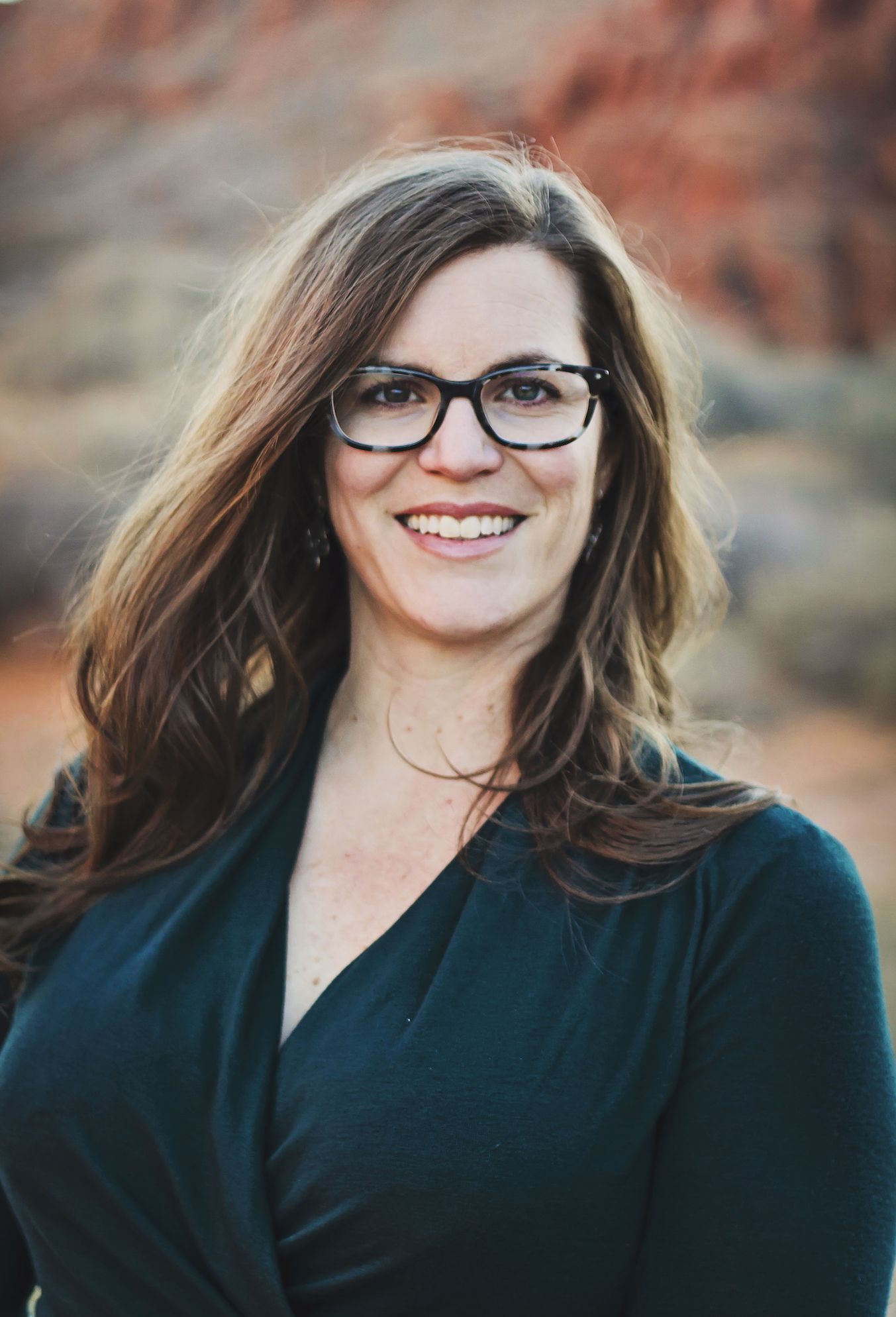
Dr. Anna Smith
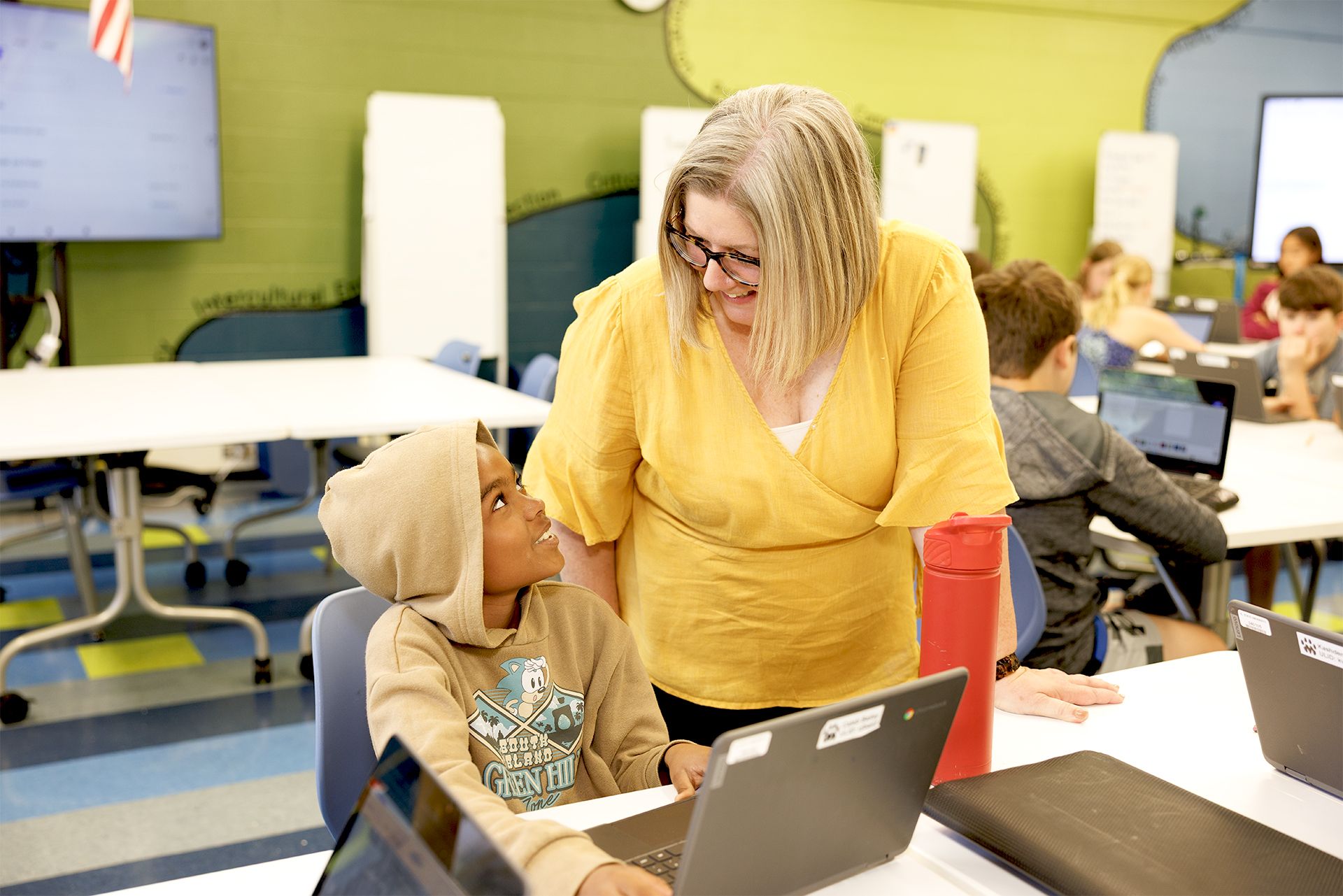
Caleb Bailey and Kristi Sutter discuss inspirational messages for the Metcalf Sidewalk Joy project.
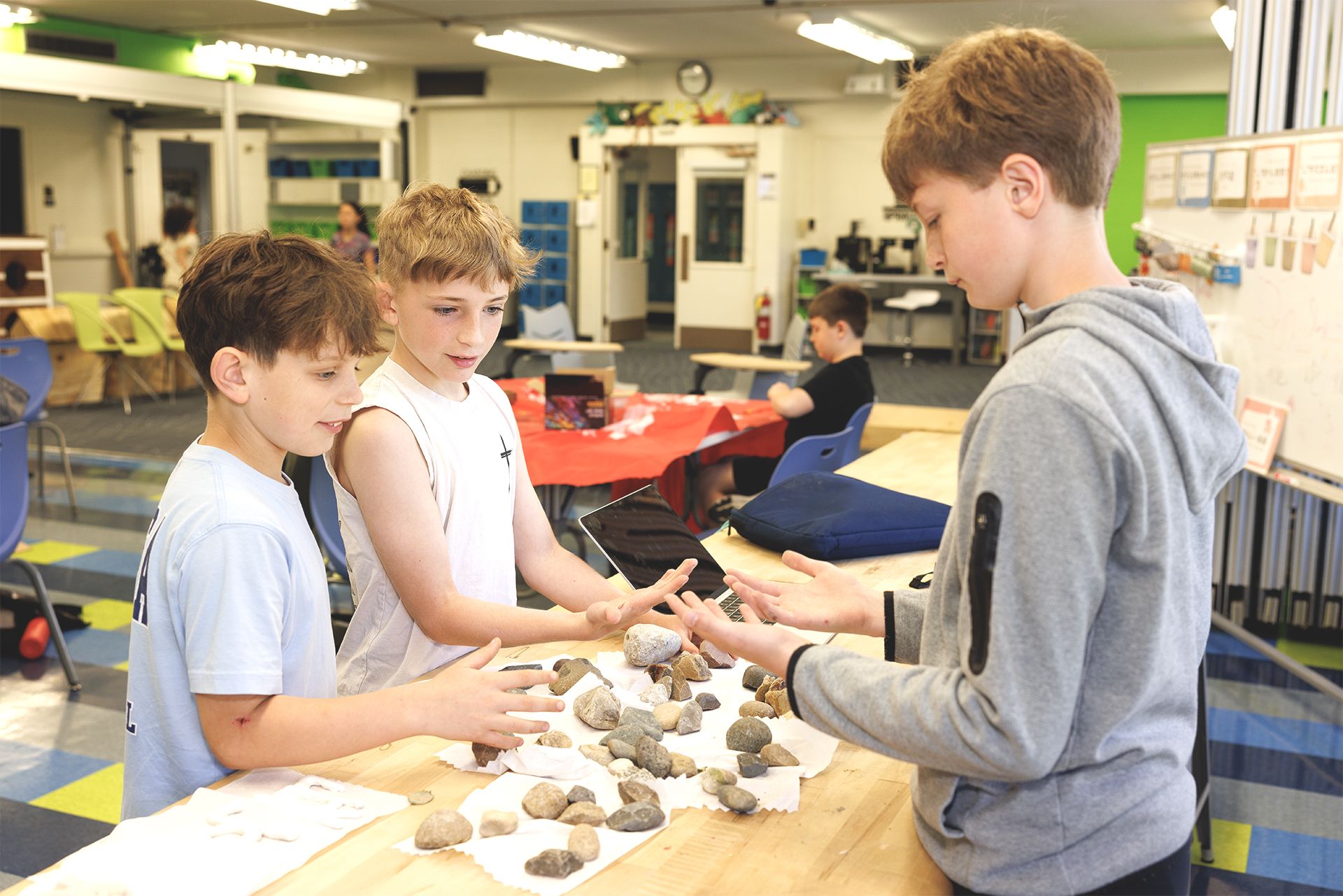
From left, Keller Sager, Tyler Marx, and Kashden Cumpston evaluate the stones best suited for their project.
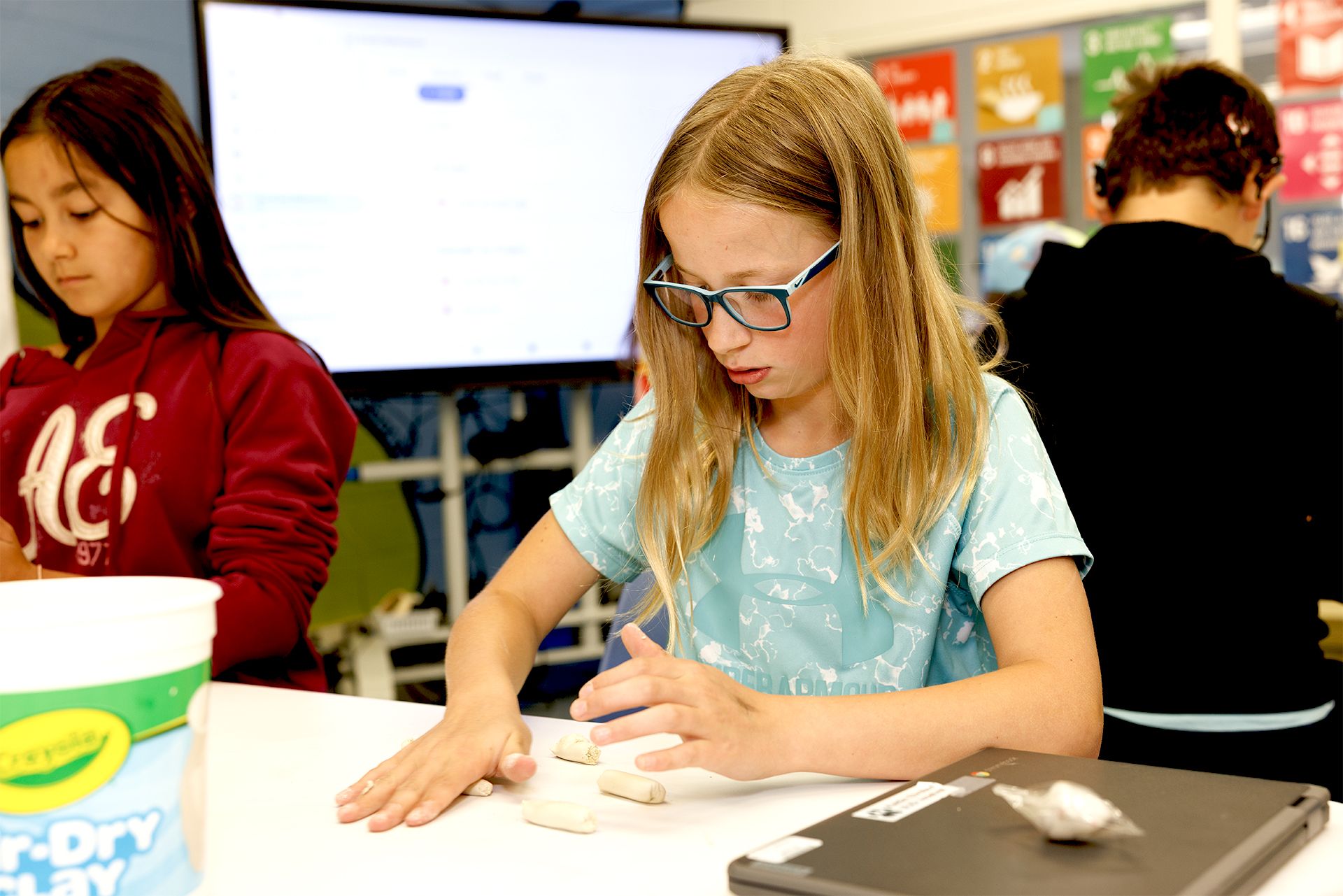
Kaitlin Ehrstein works with clay to create joy-focused keyrings to place around campus during finals week.