Illinois State University launches DHH master's degree and Chicago Public Schools
partnership
By Taylor Hochecker
When traditional recruiting methods could not fill the growing need for teachers of the Deaf and Hard of Hearing (DHH), Chicago Public Schools (CPS) turned to Illinois State University, a trusted and long-standing partner, to help design an innovative new pathway to certification.
Through this collaboration, current CPS learning and behavior specialist I teachers are completing graduate-level coursework and American Sign Language classes through Illinois State’s Department of Special Education, with full financial support from CPS. The goal is to prepare a new wave of DHH teachers who can meet the needs of hundreds of Deaf and Hard of Hearing students served by CPS each year.
The partnership began nearly two years ago when Josh Long, chief of the Office for Students with Disabilities at Chicago Public Schools, reached out to the Department of Special Education at Illinois State to explore ways to address the district’s critical shortage of DHH teachers. Despite years of active recruitment, including hiring fairs, outreach to universities, and nationwide searches, CPS continued to face significant vacancies. Fourteen teaching positions remained open even as retirees returned temporarily to fill the gap.
“Our traditional recruiting methods just weren’t bringing in enough candidates,” Long said. “We needed a new approach, one that would invest in the people already in our schools who are committed to our students and communities.”
That approach became part of CPS’s broader Grow Your Own initiative, designed to help existing educators expand their credentials to meet specialized needs within the district. Partnering with Illinois State, an institution long recognized for its strong special education programs and statewide leadership in teacher preparation, was a natural next step.
“I feel really strongly about the quality of Illinois State’s special education graduates,” Long said. “We trust them, we know their preparation, and they have always been on the right side of kids. When we began thinking about where to build a partnership, Illinois State was our first and only call.”
Building a pathway for future Deaf and Hard of Hearing teachers
Illinois State’s Department of Special Education quickly responded, assembling a team of faculty to design graduate-level coursework that served as the foundation for a new online master’s degree in Deaf and Hard of Hearing education that officially launched in August 2026.
The program is intentionally designed for adult learners who are already working full time in schools. The first cohort of 20 CPS teachers began fall 2025.
“CPS came to us with a clear need, and together we’ve built something that directly addresses it,” said Dr. Yojanna Cuenca-Carlino, former chair of the Department of Special Education. “This collaboration is a powerful example of what happens when higher education and K-12 systems come together to solve shared problems.”
The demand for the new pathway has far exceeded expectations. When CPS sent an internal call for interested teachers, district leaders anticipated around 20 responses. Instead, more than 300 educators expressed interest within days.
“That level of enthusiasm was incredible,” Cuenca-Carlino said. “It shows how deeply educators want to expand their expertise to serve students who are Deaf and Hard of Hearing and how urgent the need is.”
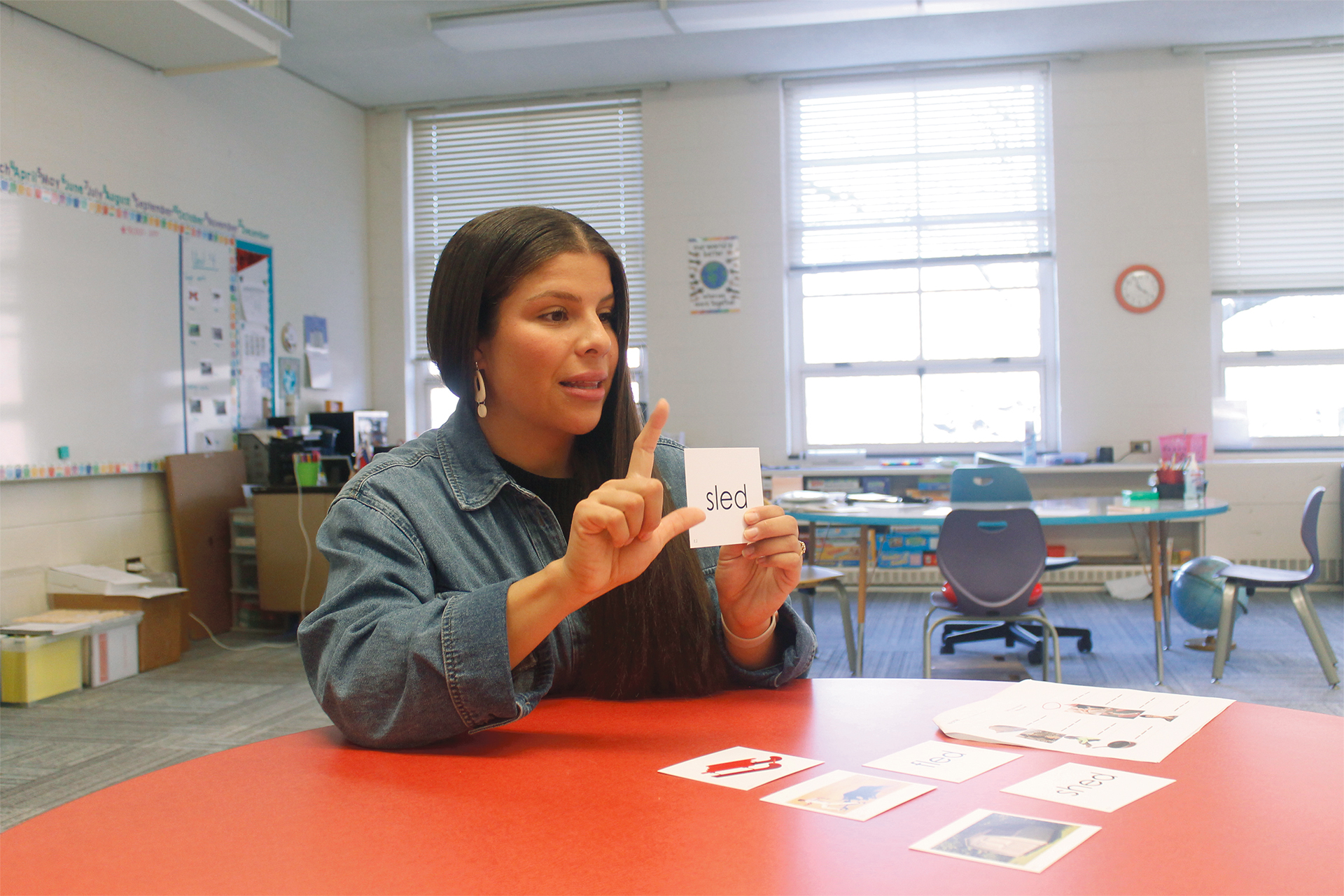
Crystal Davis ’20, M.S. ’24, works with students in her DHH classroom.
Addressing a statewide need
Illinois State University is currently the only institution in Illinois providing a Deaf and Hard of Hearing teacher preparation program. The first CPS cohort transitioned into the master’s program as inaugural students in June, and the program opened statewide in August 2026.
The initiative is already gaining momentum across Illinois. Within 48 hours of the Department of Special Education announcing its intent to develop the master’s program, 10 Illinois school districts submitted letters of support, underscoring the statewide demand for qualified teachers.
“This program not only strengthens CPS’s workforce, it will strengthen the entire state’s capacity to meet the needs of Deaf and Hard of Hearing students,” Cuenca-Carlino said. “It’s a model for how universities can partner with school districts to grow the teaching profession from within and address the ongoing teacher shortage nationwide.”
The program beyond partnership
As CPS recruited teachers for the initial partnership cohort, Illinois State faculty simultaneously worked to design a master's degree aligned with licensure requirements and national standards.
“This was always part of a larger vision,” said Dr. Allison Kroesch, associate chair and graduate advisor in the Department of Special Education. “The partnership helped accelerate the process, but our goal from the beginning was to create a master’s-level program that could meet a critical and ongoing need.”
Kroesch, who serves as liaison to CPS, has led efforts related to program development, recruitment, advising, and the approval process through the University and the Illinois State Board of Education.
The department drew on existing strengths, including its undergraduate DHH program and a master's program in low vision and blindness. The online format expands access for educators across Illinois, particularly those unable to attend in person, while maintaining academic rigor.
“We are currently the only program of this kind in the state,” Kroesch said. “Offering it online allows us to reach teachers wherever they are while maintaining the quality Illinois State is known for.”
The program is open to educators in general education and other special education areas. Built-in coursework, such as American Sign Language, supports candidates with varying levels of experience.
Designing a cohesive curriculum
A central priority was creating a program aligned across all levels of preparation. The department's DHH instructional team developed a vertically integrated system that reflects the complexity of today's DHH field.
“One of our major goals was coherence, not just within this program, but across the entire Deaf and Hard of Hearing preparation sequence,” said Dr. Christy Borders, professor of Deaf and Hard of Hearing education.
Faculty mapped competencies across undergraduate and graduate coursework to align with professional standards, licensure requirements, and evidence-based practice. The process included modifying existing courses and developing three new graduate courses.
“The work was highly collaborative,” Borders said. “We focused on how to build from foundational knowledge to more advanced skills in clinical reasoning, leadership, and data-based decision-making.”
Coursework reflects the complexity of the DHH field, including language development, literacy instruction, assessment, and collaboration with families and school teams.
“Programs like this strengthen professional preparation and ultimately improve outcomes for DHH students,” Borders said. “The quality of teacher preparation directly impacts DHH student access, language growth, and long-term academic success.”
Those interested in learning more or applying for this new graduate program can contact Dr. Allison Kroesch at SED_Graduate@IllinoisState.edu.