TACTILE TEACHING
Blind education research backed by NSF grant inspires accessible science lesson
By Bella Marello
From Illinois State University researchers to high school classrooms to elementary students, cross-campus collaboration is bringing accessible science education to life.
Inside the University High School classroom of science teacher Emily Telford ’11, M.S. ’18, students are not only relying on visual models to study the microanatomy of cells, tissues, and organs—they are running their hands across clay, beads, and textured fabrics to learn histology through touch.
This tactile teaching approach is part of a broader effort led by Dr. Natalie L. Shaheen, associate professor in the Department of Special Education (SED) and School of Teaching and Learning at Illinois State University.
The power of multimodal teaching tactics
Backed by a $1.5 million National Science Foundation (NSF) CAREER grant Shaheen received in 2024—the largest grant to a single SED faculty member in 25 years—Illinois State is reshaping how science is taught with a special focus on blind and low-vision (BLV) students.
Shaheen, who is blind, calls this approach to learning “born accessible.”
“Born accessible can apply to things beyond teaching and learning. It means that from the jump, we do things in such a way that is going to be accessible to a broad number of disabled people,” Shaheen said.
Dr. Mutiara Syifa, a postdoctoral scholar working with Shaheen in the Department of Special Education, has focused her research on how teachers can attend to students’ actions and contributions in ways that reflect their cultural backgrounds and lived experiences, particularly within the BLV community.
“When we talk about equity and inclusivity, at least in my own experience, we never really think deeply about disabled students. So, this is a chance for science teachers to think from a different angle about how we can support disabled students, specifically blind and low-vision students,” Syifa said.
Building on this work, she collaborated with science educators to design a workshop centered on developing “epistemic empathy” skills—understanding how individuals think and feel as they make sense of new knowledge.
Telford was one of the many science teachers who attended Syifa’s workshop and was eager to bring the concept back to her University High classroom.
“It was eye-opening,” Telford said. “She had some lessons where we put ourselves in the shoes of BLV students, so we could see that science doesn’t have to rely on visual aids.”
Telford was especially inspired at the workshop after hearing from Ashleigh Moon, coordinator for the National Federation of the Blind’s STEM2U program, who explained how nonvisual teaching tools can lead to a more inclusive classroom.
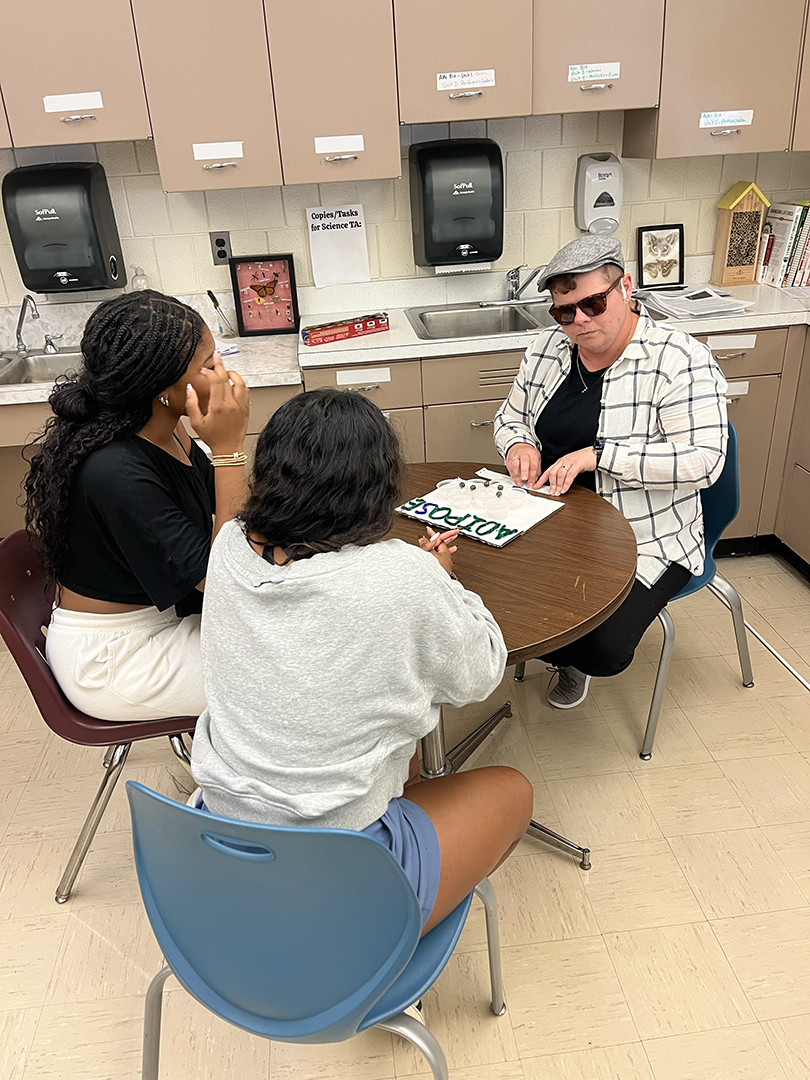
Dr. Natalie Shaheen works with U-High students on their tactile model of a cell.
Making science tangible for all
Telford redesigned her histology unit based on the workshop, presented a sample lesson to Moon, and tasked her high school students with building tactile models of cells and tissue to be understood through touch.
Some students twisted pipe cleaners into shapes and pressed textures into clay, adding Braille and audio descriptions through a QR code. Another group filled a box with large and small balls to represent red and white blood cells, and rice to depict platelets.
Hudson Carney—a U-High senior at the time of the project—worked with his group to embed clay pellets and beads into a slime-filled paper plate to create a model of white blood cells surrounded by lymph fluid.
“As I learned more about what was actually going to be accessible to kids who could potentially not see or have limited vision, that really impacted how I went about the project,” Carney said. “Not being able to use one of my senses was a key part in trying to develop this model in a way that was going to make it effective.”
He sees the project as a step toward normalizing different ways of learning.
“Being able to create projects that are not only accessible for kids who do have vision or can hear properly, but also to kids who cannot do those things—I think it is very helpful in being able to showcase that the education system is trying to move forward to actually represent those students,” Carney said.
After students completed the first draft of their projects, Shaheen visited the classroom to offer feedback from the perspective of a blind individual.
“They blew me away,” Shaheen said. “The models that the students had so far were beyond what I expected them to produce. I really just kept being in awe.”
The project didn’t end at University High. After the models were finalized, the high school class presented their work to a second-grade classroom at Thomas Metcalf School.
“It was a bit chaotic, as you can imagine, with a bunch of second graders getting to touch and feel different things that my students created,” Telford said.
To help the younger students grasp the concept of cells and tissue, Telford asked the high school students to prepare analogies.
“My favorite is the group that talked about how a cell is like a Lego, and if you build a castle, that’s a tissue, and the different types of Legos will help you change what the castle looks like. I thought that was brilliant,” Telford said.
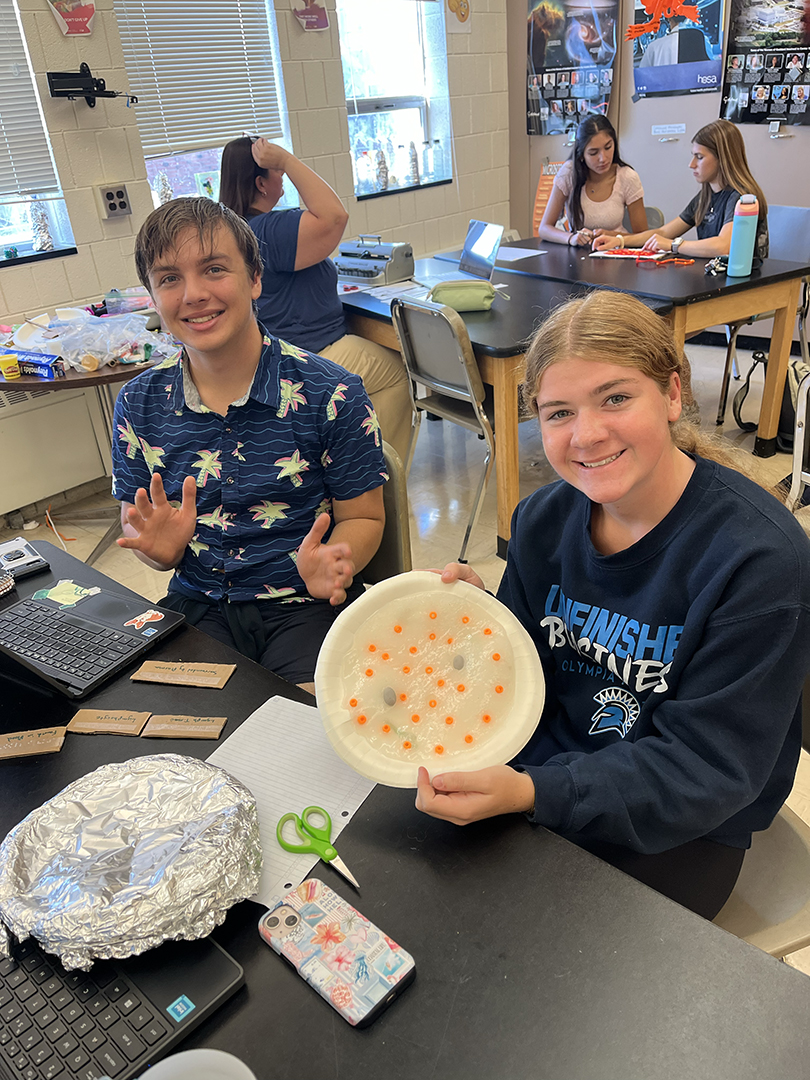
Hudson Carney ’26 and AJ Withman show their tactile white blood cell model.
‘It’s not extra work; it’s better teaching’
Syifa said presenting to a younger audience was a crucial part of the process.
“The main goal is to be able to show examples of teachers’ epistemic empathy, which I think extends to what (Telford) did in the classrooms—to also show these young students that there are people who think differently and engage differently,” Syifa said.
Syifa is looking to extend her research and produce a collection of universally accessible and inclusive lesson plans.
Telford aims to continue the lesson project for her histology unit every year and has started brainstorming how to redesign other units with accessibility in mind. She gave some advice to teachers looking to make their classrooms more inclusive.
“Start small, one lesson at a time. Think about, ‘How can I do this tactilely or visually or auditorily for my students, making things more hands-on?’ Borrow, don’t reinvent the wheel,” Telford said.
“It’s not extra work; it’s better teaching.”
This material is based upon work supported by the National Science Foundation under Award No. 2334693. Any opinions, findings and conclusions, or recommendations expressed in this material are those of the author(s) and do not necessarily reflect the views of the National Science Foundation.